Introduction
Every child develops at their own pace. Some children start speaking early, while others take more time to express their thoughts, understand words, or communicate with people around them. However, when a child consistently struggles to speak, understand instructions, pronounce words, or interact with others, parents should pay attention to these signs. Choosing the right Rehabilitation Centre in Gurugram can help parents access professional guidance and appropriate speech therapy support to improve their child’s communication skills.
Communication is an important part of a child’s overall development. It helps children express their needs, share emotions, make friends, participate in classroom activities, and build confidence. When communication becomes difficult, it can affect several areas of everyday life. The good news is that the right guidance and timely speech therapy can help children develop better communication skills.
Finding a suitable Rehabilitation Centre in Gurugram can be an important step for parents who want professional support for their child’s speech and language development. NeuroLink Rehab Centre focuses on rehabilitation support and child development, helping families understand the importance of structured therapy and consistent practice.
What Is Speech Therapy and Why Is It Important for Children?
Speech therapy is a specialised intervention that helps children improve their ability to communicate. It focuses on developing speech sounds, understanding language, using words, forming sentences, and communicating effectively with others.
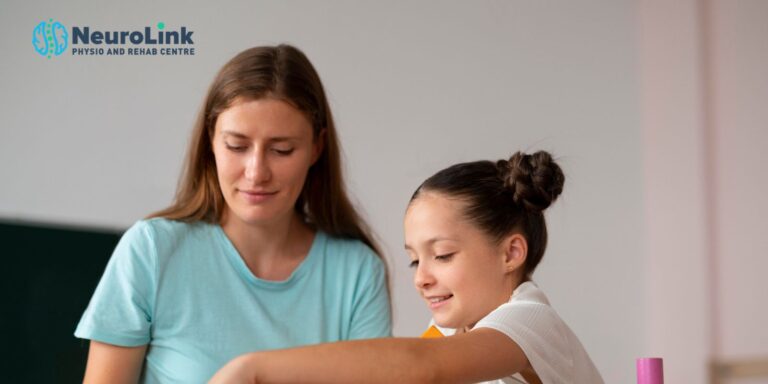
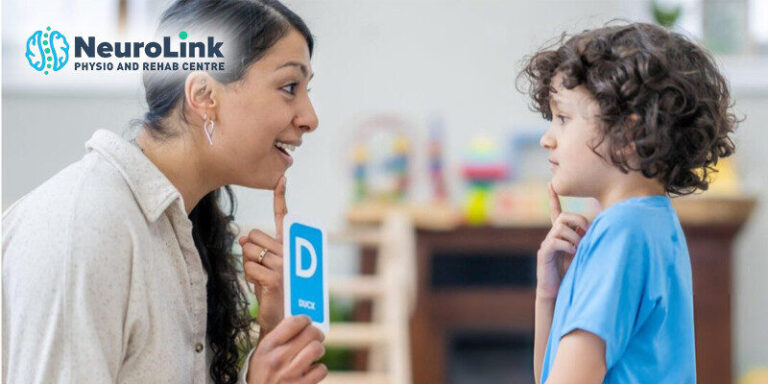
A speech-language therapist works with children according to their individual communication needs. Therapy sessions may include activities, games, picture cards, storytelling, conversation exercises, and interactive learning.
Parents looking for a Rehabilitation Centre in Gurugram should understand that speech therapy is not only about teaching children to speak. It also helps them understand what others are saying, express their feelings, follow instructions, and participate in social situations.
For example, a child who struggles to ask for water may become frustrated because they cannot communicate their needs. Speech therapy can work on helping that child express the request through words, gestures, pictures, or other appropriate communication methods.
The main purpose is to make communication easier and more meaningful for the child.
Common Communication Difficulties in Children
Every child has different developmental needs. Some children may have difficulty speaking, while others may understand words but struggle to form sentences. Recognising these difficulties can help parents seek appropriate support.
Here are some common communication challenges that children may experience.
1. Speech Delay
Speech delay occurs when a child develops spoken language skills later than expected for their age. A child may use fewer words, take longer to start speaking, or struggle to combine words into simple sentences.
For example, a child may communicate mostly through pointing, gestures, or sounds instead of using words.
A professional assessment at a Rehabilitation Centre in Gurugram can help parents understand their child’s communication development and whether speech therapy may be helpful.
2. Difficulty Pronouncing Words
Some children have trouble producing certain speech sounds. They may replace one sound with another, leave out sounds, or pronounce words in a way that makes them difficult to understand.
For example, a child may say a word incorrectly even after hearing the correct pronunciation several times.
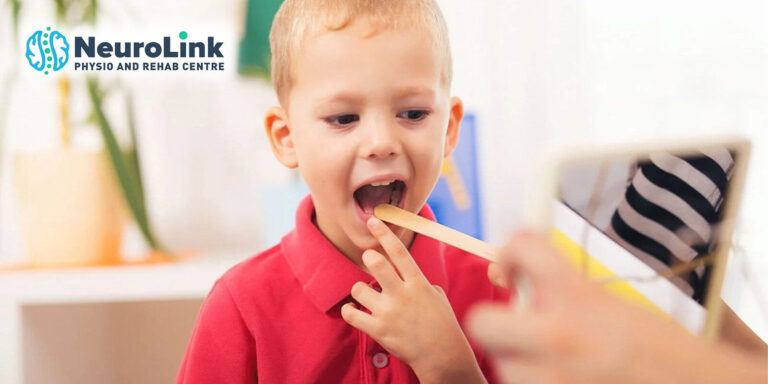
Speech therapy can include age-appropriate sound practice, listening activities, and guided speaking exercises to support clearer pronunciation.
3. Difficulty Understanding Language
Communication is not only about speaking. Children also need to understand what others are saying.
Some children may struggle to:
- Follow simple instructions.
- Understand questions.
- Identify familiar objects.
- Understand basic concepts such as big, small, up, and down.
- Respond appropriately during conversations.
A therapist can use pictures, objects, demonstrations, and interactive activities to support language understanding.
4. Limited Vocabulary
Vocabulary refers to the words a child understands and uses. Children with limited vocabulary may struggle to name familiar objects, describe their activities, or explain what they want. A specialised Rehabilitation Centre in Gurugram can help parents explore speech therapy support to improve their child’s vocabulary, language understanding, and everyday communication skills.
For example, instead of saying, “I want to play with my ball,” a child may only point towards the ball.
A structured speech therapy programme can help introduce new words and encourage children to use them in meaningful situations.
5. Stammering or Stuttering
Some children repeat sounds, syllables, or words while speaking. They may also stretch sounds or experience difficulty getting words out smoothly.
Occasional repetitions can happen during childhood language development. However, persistent speech difficulties, physical tension, or distress while speaking should be discussed with a qualified professional.
Speech therapy can help children develop comfortable communication habits and reduce the stress associated with speaking.
6. Social Communication Difficulties
Some children find it difficult to start conversations, take turns while speaking, respond to others, or understand social cues.
They may struggle to communicate during group activities, play with other children, or express their emotions.
Parents searching for a Rehabilitation Centre in Gurugram should consider whether their child needs support not only with spoken words but also with everyday social communication.
Signs Your Child May Need Speech Therapy
Parents often wonder whether their child’s speech development is progressing normally. Although children develop at different rates, certain signs may indicate that a professional assessment is needed.
Look out for the following:
- Your child uses very few words compared with age expectations.
- Your child rarely uses gestures such as pointing or waving.
- Your child struggles to follow simple instructions.
- Your child has difficulty expressing basic needs.
- Your child does not combine words when expected for their developmental stage.
- Your child is difficult to understand, even for familiar family members.
- Your child avoids conversations or has difficulty interacting with other children.
- Your child frequently becomes frustrated because others cannot understand them.
- Your child has difficulty answering simple questions.
- Your child loses communication skills that they previously had.
If you notice these signs, do not simply wait for your child to grow out of the difficulty. An assessment at a Rehabilitation Centre in Gurugram can help identify the areas where your child needs additional support.
It is also important to remember that losing previously acquired communication skills requires prompt professional evaluation.
How Speech Therapy Supports Children with Communication Difficulties
Speech therapy uses structured and engaging activities to help children improve their communication abilities. The therapy approach depends on the child’s age, developmental level, strengths, and individual difficulties.
Here are some important ways speech therapy can support children.
1. Improving Speaking Skills
Speech therapy helps children learn how to use sounds, words, and sentences to communicate their thoughts.
Therapists may use naming games, repetition exercises, picture identification, and everyday conversation activities.
For example, if a child knows the names of objects but struggles to use them in sentences, therapy may gradually encourage them to move from single words to simple phrases.
A Rehabilitation Centre in Gurugram that provides appropriate speech and language support can help parents understand how these activities fit into their child’s development.
2. Building Vocabulary
Children need a good vocabulary to express their needs, describe experiences, and understand conversations.
Speech therapy may introduce new words through:
- Picture cards.
- Storybooks.
- Everyday objects.
- Action-based games.
- Songs and rhymes.
- Naming familiar people and things.
For example, while playing with toy animals, a therapist may introduce words such as dog, cat, cow, eat, run, and sleep.
Repeated exposure and meaningful practice can help children understand and use new vocabulary.
3. Developing Sentence Formation
Some children know individual words but find it difficult to combine them into meaningful sentences.
Therapy can help children gradually develop longer and more organised sentences.
For example:
- Single word: “Ball.”
- Two words: “Want ball.”
- Simple sentence: “I want the ball.”
- Expanded sentence: “I want to play with the red ball.”
These activities help children communicate more clearly according to their developmental abilities.
4. Improving Listening and Understanding Skills
Listening and understanding are important parts of communication.
Speech therapy may include activities that teach children to identify sounds, understand questions, recognise objects, and follow instructions.
For example, the therapist may ask the child to pick up a toy, identify a particular colour, or place an object inside a box.
These activities can support receptive language, which refers to the ability to understand spoken or other forms of communication.
5. Supporting Clear Pronunciation
Children who struggle with speech sounds may benefit from targeted pronunciation exercises.
A therapist first identifies the sounds that the child finds difficult and then plans suitable activities.
These may include listening to sounds, practising sound production, saying words, and using the sounds in short sentences.
The objective is to help the child become easier to understand in everyday conversations.
6. Encouraging Social Interaction
Communication plays an important role in making friends and participating in group activities.
Some children need support with conversation skills, taking turns, greeting others, asking questions, and responding appropriately.
Therapy may use pretend play, role-playing, storytelling, and interactive games to practise these skills.
For example, a child may practise saying hello, asking for a toy, waiting for another person’s turn, and responding to a simple question.
A Rehabilitation Centre in Gurugram can help families explore appropriate developmental support when social communication is one of their child’s challenges.
7. Building Confidence and Reducing Communication Frustration
Children may feel frustrated when they cannot explain what they want or when others repeatedly misunderstand them.
Speech therapy encourages children to communicate in ways that match their abilities. This may involve spoken words, gestures, signs, or picture-based communication.
As children become more comfortable expressing their needs, everyday interactions may become easier.
Progress differs from child to child, and building confidence is an ongoing process.
What Happens During a Child’s Speech Therapy Session?
Many parents feel unsure about what to expect during a speech therapy session. In reality, sessions at a Rehabilitation Centre in Gurugram are often designed around engaging activities, interactive games, and child-friendly exercises rather than formal classroom-style teaching.
A typical therapy process may include the following stages.
Step 1: Initial Assessment
The therapist gathers information about the child’s communication abilities, developmental history, current difficulties, and everyday interactions.
Parents may be asked about the child’s first words, vocabulary, listening skills, behaviour during conversations, and language exposure at home.
Step 2: Identifying Communication Needs
After the assessment, the therapist identifies the areas that may need support.
These may include speech sounds, vocabulary, sentence formation, language understanding, fluency, or social communication.
Step 3: Individualised Therapy Planning
Every child has different strengths and challenges. Therefore, therapy activities should be selected according to the child’s individual needs.
A suitable Rehabilitation Centre in Gurugram should encourage an individualised approach rather than assuming that the same activities will work for every child.
Step 4: Interactive Therapy Activities
Therapy sessions may include games, picture matching, storytelling, object identification, sound practice, and conversation activities.
These exercises make learning more engaging and encourage children to participate.
Step 5: Progress Monitoring
The therapist observes the child’s development and adjusts activities when required.
Parents may also receive guidance on how to practise communication skills at home.
Speech Therapy Activities Parents Can Practise at Home
Parents play an important role in supporting communication development. Children have many opportunities to practise language during everyday activities.
Here are some simple activities parents can try.
1. Read Storybooks Together
Choose colourful picture books and talk about the images.
Ask simple questions such as:
- What is this?
- Where is the dog?
- What colour is the car?
- What is the boy doing?
Allow your child enough time to respond.
2. Talk During Daily Activities
Use everyday routines to introduce new words.
For example, while eating, talk about food, colours, tastes, and actions. While getting dressed, introduce words such as shirt, shoes, socks, and buttons.
This helps children connect words with real experiences.
3. Play Naming Games
Show your child familiar objects and encourage them to name them.
You can use toys, fruits, household items, animals, and pictures.
If the child cannot say the word, provide a clear example without pressuring them.
4. Encourage Choices
Instead of immediately giving your child everything, offer simple choices.
For example, ask, “Do you want an apple or a banana?”
Your child can respond through words, gestures, pointing, or another communication method.
5. Sing Songs and Rhymes
Songs and rhymes introduce rhythm, sounds, repetition, and familiar words.
Choose simple songs and encourage your child to participate at their own pace.
6. Reduce Background Distractions
During conversations and learning activities, switch off unnecessary television or background noise.
Give your child your attention and allow enough time for communication.
Parents should remember that home activities are meant to support professional guidance, not replace an appropriate assessment or therapy programme.
What Is the Role of Parents in Speech Therapy?
A child’s communication development does not happen only during therapy sessions. Family participation is equally important.
Parents can support progress by creating a positive communication environment at home.
Some helpful practices include:
- Speak slowly and clearly using natural language.
- Listen patiently when your child tries to communicate.
- Avoid interrupting or constantly correcting speech.
- Encourage attempts to express thoughts and feelings.
- Read books and tell simple stories regularly.
- Give your child enough time to respond.
- Practise activities suggested by the therapist.
- Communicate with teachers about the child’s needs.
- Celebrate small achievements without putting pressure on the child.
Parents looking for a Rehabilitation Centre in Gurugram should choose a centre that values family involvement and provides practical guidance for everyday communication.
Does Speech Delay Mean a Child Has Autism?
No. Speech delay does not automatically mean that a child has autism.
Speech and language difficulties can occur for several reasons. These may include hearing difficulties, developmental language disorders, speech sound disorders, broader developmental differences, or other factors. A Rehabilitation Centre in Gurugram can help identify a child’s communication challenges and guide parents towards suitable assessment and therapy support.
Autism can also involve differences in social communication and interaction, along with restricted or repetitive behaviours and interests.
Some autistic children may have delayed spoken language, while others may develop spoken language but experience difficulties with social communication.
If parents notice communication delays along with differences in social interaction, play, or behaviour, they should consult an appropriate healthcare professional for a comprehensive developmental assessment.
A Rehabilitation Centre in Gurugram may provide relevant rehabilitation support depending on its services and the child’s assessed needs. However, speech therapy alone should not be treated as a substitute for a comprehensive autism assessment.
Can Children Improve Their Communication Skills Through Speech Therapy?
Yes, speech therapy can support children in developing communication skills when the intervention is suitable for their individual needs.
However, progress is different for every child. Some children may begin using more words, while others may first improve their understanding, gestures, attention during interaction, or ability to communicate basic needs.
Several factors can influence progress:
Age and developmental needs: Early identification can help children access support when communication difficulties are noticed.
Consistency: Regular therapy and appropriate home practice provide opportunities to use communication skills in different situations.
Individual therapy goals: Activities should match the child’s current abilities and developmental needs.
Family participation: Parents and caregivers can help children practise communication during everyday routines.
Professional guidance: Progress should be monitored, and therapy goals should be adjusted when necessary.
The purpose of speech therapy is to help children communicate as effectively and independently as possible, rather than compare their progress with other children.
Why Choose NeuroLink Rehab Centre for Child Development Support?
Choosing the right rehabilitation support is an important decision for parents. A child’s communication needs deserve patience, understanding, and an approach that recognises individual differences.
NeuroLink Rehab Centre is a rehabilitation-focused centre that supports individuals who need developmental and rehabilitation assistance.
For parents exploring a Rehabilitation Centre in Gurugram, it is important to understand the services available and discuss whether the centre can meet their child’s specific communication needs.
When evaluating a rehabilitation centre, consider the following factors:
- Availability of qualified speech-language professionals.
- Individual assessment of the child’s communication needs.
- Therapy goals based on the child’s developmental level.
- Child-friendly and engaging therapy activities.
- Parent guidance and home practice support.
- Regular monitoring of progress.
- Coordination with other professionals when required.
At NeuroLink Rehab Centre, parents can enquire about available child development and rehabilitation services to understand the appropriate support options for their child.
The right approach should focus on the child’s abilities, comfort, participation, and everyday communication needs.
When Should Parents Consult a Speech Therapist?
Parents should not wait until their child starts school to discuss communication concerns.
If a child is not developing communication skills as expected, has difficulty understanding everyday instructions, struggles to express basic needs, or experiences persistent pronunciation difficulties, a professional assessment can help.
Parents should also seek prompt advice if a child loses words or communication skills they previously used.
An evaluation can help determine whether the child needs speech therapy, hearing assessment, developmental evaluation, or another form of professional support.
Finding a suitable Rehabilitation Centre in Gurugram can help parents take an informed step towards understanding their child’s needs.
Remember, asking for professional guidance does not mean that something is necessarily wrong. It simply helps parents understand their child’s development and available support.
Frequently Asked Questions (FAQs)
1. What is the right age to start speech therapy for children?
Speech therapy can be considered whenever communication concerns are identified. There is no need to wait for a particular age if a child is showing signs of speech or language difficulties. Early assessment helps identify the child’s needs and suitable support.
2. How do I know if my child needs speech therapy?
If your child has difficulty using words, forming sentences, understanding instructions, pronouncing sounds, or communicating with others, consider consulting a qualified speech-language therapist for an assessment.
3. Can speech therapy help children who are not talking?
Yes. Speech therapy can support children with limited or no spoken language by developing functional communication. Depending on the child’s needs, therapy may use sounds, gestures, signs, pictures, or augmentative and alternative communication (AAC).
4. How long does speech therapy take to show results?
There is no fixed timeline. Progress depends on the child’s communication needs, developmental abilities, therapy goals, consistency, and family participation. Some children may show changes earlier, while others need longer-term support.
5. Can parents support speech development at home?
Yes. Parents can support communication by reading stories, singing songs, talking during daily activities, playing naming games, offering choices, and following the therapist’s home practice guidance.
6. Is speech delay always related to autism?
No. Speech delay can have different causes, and not every child with speech difficulties is autistic. A comprehensive assessment by appropriate professionals can help understand the child’s developmental needs.
7. Can bilingual children receive speech therapy?
Yes. Children who speak or hear multiple languages can receive speech therapy. Learning more than one language does not automatically cause a speech or language disorder. Assessment should consider the child’s communication abilities across the languages they use.
8. How can I find a suitable Rehabilitation Centre in Gurugram?
Look for a centre that offers appropriate child development services, access to qualified professionals, individualised therapy planning, parent involvement, and regular progress monitoring. Ask about the available speech therapy services before choosing a centre.
9. Does speech therapy only focus on speaking?
No. Speech therapy can address understanding language, vocabulary, sentence formation, pronunciation, fluency, social communication, and functional communication through different methods.
10. How can I enquire about child rehabilitation services at NeuroLink Rehab Centre?
You can contact NeuroLink Rehab Centre to enquire about its available child development and rehabilitation services, discuss your child’s communication concerns, and understand the next steps for an appropriate assessment.
📞 Contact Us: 97 0303 0405
🌐 Explore Our Services:
https://neurolinkrehab.com/services/
📱 Follow Us on Instagram:
https://www.instagram.com/neurolink.hyd
📘 Follow Us on Facebook:
https://www.facebook.com/neurolinkrehab
NeuroLink Rehab — Supporting Better Recovery, Mobility & Independence.